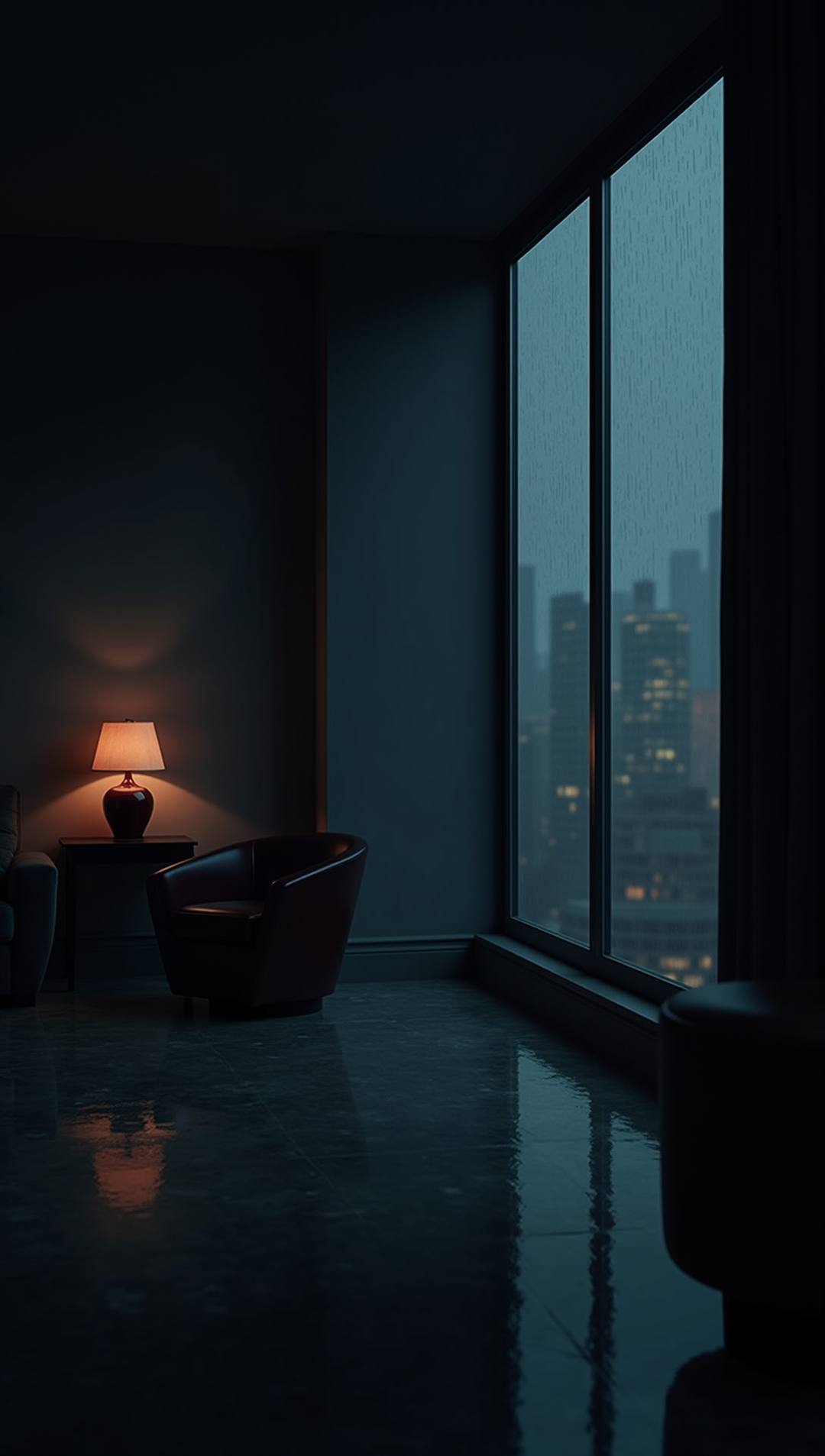
Season 01 · Episode 1
The Last Client
The smell came first.
Metal, lemon polish, copper. In the middle of a very clean room, it was the one thing that could not be hidden: a warm, thin, stubborn line of copper hung in the air.
Elena noticed her knees had locked only afterward. First she noticed her hand. Her fingers were moving forward as if they had made their own decision. Not the palm; only two fingers. The smallest, stupidest excuse of a hand that knew it should not touch.
The skin on the floor had begun to cool. Not quite cold. Not quite warm. That lukewarm border in between, the one that forces a person into denial. Elena held her breath. The lawyer inside her said one word: evidence. Something older and barer inside her reached for another: help.
Even the silence of the room was orderly. A ventilation unit running somewhere far off, a fine tremor in the glass of the iced-water carafe, the noiseless light of an expensive lamp left on somewhere. None of it was asking for help. Only the thing that seemed to want Elena's hand lay on the floor.
Her fingertip touched skin first.
Then metal.
The grip of the gun was colder than she had expected; on its surface the room's light broke like a small, sharp line. In that instant Elena wanted to pull back, but the touch was already complete.
Elena Vale closed the third exhibit of the file the moment opposing counsel said "perception management."
The air in the room shifted, quietly. In Sterling & Voss's glass conference rooms, people did not raise their voices; raising your voice was the work of those with no numbers left on the table. The team across the table was large: two lawyers, a crisis consultant, a family-office representative, and three people trying to turn the division of what remained of a forty-year marriage into an emotionless spreadsheet within the hour.
Elena looked not at the crowd but at the single gap.
"If the confidentiality clause in that exhibit is signed as it stands, in two weeks your client will look like a man who silenced an innocent woman," she said. "Which is exactly the headline you're afraid of."
Opposing counsel's hand went to his pen. Elena did not go on. She gave people time to finish the sentence they feared, on their own. Power was the ability to stop in the middle of a sentence.
Ten minutes later the clause changed. Twenty minutes later the crisis consultant looked at Elena's side of the table for the first time. Thirty minutes later there was an outcome no one called a victory. Elena did not use a red pen; red made people go on the defensive. Blue ink looked less personal and killed the same sentence more quietly. As the room emptied, Elena's client did not cry; she only held her bag with both hands. Elena did not give her a napkin.
In the corridor, Julian Sterling was waiting for her. His gray suit carried no trace of the day; lunch, meetings, bad news — all of it slid off him and moved on.
"You took responsibility for that clause yourself," he said.
"The client couldn't."
Julian's smile was paternal. "Absorb the damage alone, and you protect the rest."
Elena had heard this ten years ago too. Perhaps in the same tone. Perhaps softer. She did not stop to remember.
Her phone buzzed as the elevator doors were opening. Céline Marchetti had placed her third unscheduled call. Elena did not answer; she read the message.
You need to come. This can't wait until tonight.
Céline always spoke in emergencies, but genuine urgency and performed urgency did not sound the same. Elena made her living off that difference.
At 17:06 Céline sat in the chair in Elena's office, opening and closing the clasp of her bag with hands whose skin was thin as glove leather. No jewelry. It was a choice more expensive than jewelry. That day, Céline seemed to have stopped hiding.
"Adrian is going to pull the settlement," she said.
"Adrian is threatening to pull the settlement," Elena said. "The two are not the same thing."
"This time they are."
Elena looked not at her face but at her bag. "What did you take?"
Céline gave a brief laugh — not because she wanted to, but because panic had found a muscle movement that resembled laughter. "You always look at what I'm hiding."
"If you're not hiding it, you'll show me."
Céline took a narrow, cream-colored notebook out of her bag. A single page was visible between its covers: numbers, fragments of dates, short marks beside them. Like an index. Not a confession, but a map. Elena did not read the text on the page. Céline had covered the lines with her finger.
"I have something that will finish him," Céline said.
The words "finish Adrian Marchetti" were not easy to say. The man showed his anger not by shouting but through payment schedules, board seats, and friendly reminders. Elena did not think he was cruel. Cruelty was too messy a word. Adrian was results-driven; some results crushed people.
"How did you get it?" Elena asked.
Céline's eyes dropped to the notebook. "Don't ask that question now."
"Now is exactly when I have to ask it."
"If I give this to the right person, Adrian loses me not in court but in his own house."
"Who is the right person?"
Céline did not answer.
Elena rose from the edge of the desk. The single page revealed more through its form than its content: vague marks beside dates; some lines had not been crossed out, while the edge of the page had been folded. It could be evidence. It could also be poison. How a record was obtained was more lethal than what the record said.
"Give it to me," she said. "I'll separate what can be used from what will burn you. Don't meet anyone tonight. Don't give a copy to anyone. Especially not to someone who'd turn it into a story."
"Don't try to protect me."
"You're my client."
"No," Céline said. "I'm the last disaster you can still control."
It was not the sentence but its exhaustion that stopped Elena. Céline was no longer speaking in anger. There is a certain calm in the voice of women who have made up their minds; Elena had heard that voice at divorce tables, just before a signature, and sometimes just before an irreversible mistake.
"Céline."
"I'm going to do something," Céline said. "You won't like it."
Elena did not reach for the notebook. Forcibly touching something in a client's hand could look like protection. It would also take away her right to choose.
Even knowing this, the first thing that crossed her mind was to take the notebook and lock it in the safe.
Céline pushed the page back into the notebook. This time the clasp of the bag closed. The small metal sound stayed in the room longer than it should have.
"Keep your phone on tonight," Céline said.
Elena did not walk her to the elevator. Sometimes seeing someone to the door was admitting you were letting them go.
As the doors closed, the same resolve remained on Céline's face.
At 20:31 the message came: Now. Come alone. Elena changed her shoes before writing a reply; that too was a reply.
When Noah Reed checked the time for the second time in the mirrored wall of the hotel bar, it was 21:12.
He would have wanted a better reason to come back to New York. A cleaner one. Records pulled from a woman's divorce file, an unmarked envelope, a message clipped down to a single word: tonight. But good stories never arrived clean. Stories that arrived clean had usually been laundered by someone's lawyer.
Céline Marchetti was going to hand him something. She had not said exactly what. That had not bothered Noah. People rarely brought the truth, especially the expensive truth, with the headline attached. His job was to find the missing sentence underneath the headline.
The bar was a few minutes' walk from Céline's building. Above the glass door that faced the street from the lobby, a small red camera light glowed. Noah noticed things like this: who came in, who went out, who did not mind being seen. Once, that habit had won him an award. Then, in a legal proceeding, a single name came to light, the source vanished, and editors began to pick up the phone less often.
A little past 21:15, Noah recognized Elena Vale before she came through the glass door.
Not by her walk. Not by her perfume either; in the cold air coming off the street, the scent could not have reached him. What gave her away was the way she paused for a second as she came to the door. Before entering a dangerous room, Elena read not the door itself but its exits.
The hotel door closed behind the two of them at 21:17. The digital screen above the front desk was bright and merciless. At that moment Noah noticed only that Elena's expression did not change when she saw him.
"Noah."
Ten years had not been enough to make his name sound less familiar in her mouth. That was unfair.
"Did you come for your client," he said, "or to decide someone else's future for them again?"
Elena's gaze slid to the street. To Céline's building. Then back. "You shouldn't be here."
"Which part of my career did you mean by that sentence?"
A dry expression crossed her face. It was not a smile. "I meant tonight."
Noah gestured to the table in the corner of the bar. "Then be quick. Someone is going to give me something."
Elena did not sit. "Did Céline talk to you?"
He answered by not answering. "Do you still believe you carry people's secrets better than they do?"
This time she sat. She did not undo the button of her coat. She sat not like someone ready to flee, but like someone keeping the option of standing as leverage. Noah remembered this too.
"Céline is in a panic," Elena said. "People in a panic give the right thing to the wrong person."
"Am I the wrong person?"
"You publish."
"Sometimes it works."
"Sometimes it kills people."
The sentence dropped onto the table. Noah watched the waterline on the rim of the glass. "You're the one saying this?"
When Elena went quiet, an old door of anger opened in Noah. "Ten years ago you exposed my source's name in a legal proceeding. The man vanished. The story died. If you're going to lecture me on the ethics of publishing, at least update the syllabus."
Elena's fingers went to the clasp of her bag, then stopped. An old habit. Not when she was preparing to lie; she did it when she was deciding not to say something.
"What happened to your source—" she said.
"Is there an end to that sentence?"
"There is."
"But it doesn't belong to me, is that it?"
A waiter came and asked what they wanted to drink. Without thinking, Elena said, "Soda water. No ice." She did not look at Noah. "And a black coffee for him."
Noah no longer drank coffee at night. But her remembering it hurt him more than the fact that he had changed.
What remained unsaid was still at the same table. At one point Elena undid the button of her coat for the first time. When the waiter set the check down in a small black dish, it was 22:31. Noah saw the time on it: 22:31, two black coffees, one soda, a glass of water no one had touched.
"Do you know what Céline has?" he asked.
Elena's face closed. It was a very small movement. Someone else would not have seen it. Noah was not someone else.
"I won't discuss my client's file with you."
"You never discussed anything with me anyway."
"That's not true."
"Lena," Noah said, without meaning to.
The name fell between them like an old key. Noah remembered that he had decided, ten years ago, never to use that name again.
Elena stood. It was 22:35; this time the camera at the lobby door must have recorded them not together but one after the other.
"Stay away from this file," she said.
"Are you trying to protect me?"
"I'm trying to keep you out of it."
"You always decide the difference."
When they stepped out onto the street, the air was colder. At 22:40 Noah stood on the sidewalk and watched her cross to the other side. Elena walked toward Céline's building. In that moment Noah thought the handoff was only running late.
Elena's key fob glowed green at 22:50.
The doorman looked up. He had one of those faces trained not to react. The lobby was silent. In the low light of the night shift, the marble looked like milk. The camera on the ceiling did not blink. In that moment Elena saw this as security.
The elevator reached the floor at 22:51. In the corridor the carpet swallowed every sound. Céline's door was not fully closed.
Elena said her name first. Then repeated it, lower. When she pushed the door open, the living-room lamps were on. Not a single glass had been knocked over. The curtains were in place. In expensive rooms, catastrophe sometimes looked very orderly; as if someone had paid, in advance, even for the right to make a mess.
Céline was on the floor.
Elena's first thought was not that Céline was dead. Even a lawyer's mind says some words late. Before her knees gave out she set down her bag, reached for her phone, then noticed the phone was already in her hand. The blood was not disappearing into the dark pattern of the carpet.
The handgun lay a hand's width from Céline's fingers.
Elena knew she should not touch it. She knew. And still she reached first for Céline's neck, then touched the grip with two fingers to move the gun away from Céline. Skin. Metal. Cold.
By the time the touch was complete, the mistake had already been made.
The ledger was gone. Neither the narrow cream notebook Céline had shown her in the office nor the black-clipped envelope that should have been on the living-room table was there. The moment Elena saw this, her fear took shape. Then, at 22:57, she got through to 911 and heard her own voice come out so flat she barely recognized it.
At 07:40 in the morning, Detective Marisol Reyes sat down across from Elena in a room whose door was not locked.
This was not an arrest. Reyes did not say so; she did not need to. The door was open, a water bottle sat on the table, Elena could stand up if she wanted. Even when a person was free to get up, doing so could make them look guilty. Reyes knew this. So did Elena.
"You were the last one in," Reyes said.
She was not rude. Not tired, either. She had the ease of someone with a file to back her. "22:50, key fob. 22:50, lobby camera. Elevator log right after. No recorded entry to the apartment after you."
"Recorded," Elena said.
Reyes tilted her head slightly. "Good. You like the gaps too."
Elena did not answer.
"If you're looking for a gap for the killer, so am I," Reyes said. "But right now what I have isn't a gap. It's you."
"You said you touched the gun."
"It was near Céline."
"You moved it away."
"Yes."
"Why?"
Because a gun lying beside a dead body still looks like a threat. Because sometimes a person looks not at the evidence but at the body. Because Elena Vale, when she saw a half-second chance to protect someone, decided first with her hand and only then with her mind.
"I don't know," she said.
Reyes did not take a note. "The gun is registered to Adrian Marchetti."
The air in the room did not change, but in Elena's mind the table turned. Adrian's registered gun. Céline's missing ledger. Elena's touch. The last entry at 22:50. The pieces sat too neatly. Neat enough to construct not the truth but the story that was easiest to tell.
"Then you're talking to Adrian," Elena said.
"We're talking. His lawyers are talking to us too. They talk very expensively." For the first time Reyes lifted her eyes from the file. "But the question of how Adrian's gun got there doesn't cancel the question of why you came there."
Elena had the sentence ready: Céline was collecting records. She was afraid. She had something to use against Adrian. She was preparing to see someone. The ledger is gone.
She did not say it.
Céline was dead. She had not stopped being a client.
Reyes watched her silence. "You're not telling me something."
"I've told you everything I can tell you."
"Those are two different things."
Elena's throat went dry. Privilege was sometimes an invisible pane of glass that cut the very hand reaching for one's own innocence. She could say the sentence and save herself. She could say the sentence and shatter her profession, her oath, Céline's right to confidentiality, which endured even after death.
Reyes had not named it directly. So Elena could not answer directly.
"The medical examiner isn't giving an exact time," Reyes said. "The first look suggests the death was before your call. The report will tell us how much earlier. A wide window doesn't put you in the clear."
Elena rebuilt, in her own mind, the line Reyes was drawing. Just after 21:15 Noah had stopped her at the door. At 21:17 the hotel lobby had let them both in. At 22:31 there was the bar check. At 22:35, the exit camera. At 22:40 they had parted. At 22:50 she had entered Céline's building. If the death fell into the narrow band the body was describing, between 21:20 and 22:10, Elena had not been there. If the report widened, Reyes would put her back in the middle of the room. Even so, the narrow physical window, though not enough on its own, became something else when joined to the right witness. Not a defense. An exit.
The only person who could prove it was the one whose own presence would ruin her absence.
Noah.
Before he called Elena, Noah deleted three drafts of the story.
In the first he had written that Céline Marchetti was murdered. In the second he could not stop himself from mentioning Adrian's registered gun. In the third, the cursor blinked for a long time where he had put Elena's name. Once, putting her name in a sentence had been easy. Sometimes too easy.
He didn't publish.
This was not virtue. Not yet. The story was at his fingertips, but he was inside the story too. The lobby camera at 21:17. The check at 22:31. The exit at 22:35. His phone held a rideshare receipt for the second car he had canceled at 22:41 because he had chosen to walk. For a journalist these were material. For a witness they were handcuffs.
Elena sent only a location in her message. Not her office. Not her home either. A narrow coffee bar two blocks over that emptied out in the afternoon. Public, but loud enough that no one would hear anyone else's sentence. A controlled risk. Like Elena.
When Noah came in at 14:05, Elena was at the back table. There was no file in front of her. Which meant there was a file.
There were two coffees on the table. Noah's was black, in a lidless cup, with half a packet of sugar beside it, exactly as he had liked it ten years ago. He no longer took sugar. He didn't say so. He knew that her remembering was more dangerous than her misremembering.
"Has Reyes reached you?" Elena asked.
"Not yet."
"She will."
"You didn't call me here to tell me that."
Elena did not touch her coffee. She had put on makeup to hide that she hadn't slept; Noah saw this too. What Elena hid would have read as an open confession on anyone else.
"If I go to the police myself," Noah said, "I start the story. If they find me, the story starts me. I wondered which one you wanted."
"What I want doesn't matter."
"That's an old lie too."
"I won't drag you into this," she said.
Noah laughed. Short, dry. "The security camera knows I was there."
"They don't need to know I spoke with you."
"Were we set dressing in that lobby for eighty minutes?"
"You don't have to give a statement."
"Are you saying that sentence to me, or to yourself?"
For the first time Elena's eyes hardened. "Noah, if you become the witness who confirms I was somewhere else at the time, you can't run the story. Every word you write becomes material for the defense, the prosecution, and the jury pool. They'll eat us alive as reconciled exes. Everyone will ask why we were together that night. There are things about Céline I cannot disclose. One wrong tone from you could be enough to sink me."
"And still, I'm your only way out."
The silence conceded that this was true.
Noah leaned over the table. "I'll be your alibi."
There was no relief on Elena's face. Only a new calculation.
"In return," Noah said, "you help me find what Céline was going to give me."
"No."
"That was quick. The answer has never been simple. You just like making decisions before anyone else gets a say."
Elena did not look away. "You don't know where this will take you."
"Stop treating me like a child."
"It's not because I think you're a child."
"Then what is it?" Noah's voice dropped lower than he wanted. "To protect me? Because I've seen this one before. You decide what I can handle, and then you sell it to me as a sacrifice."
Elena's fingers went to the edge of the napkin on the table. Paper this time, instead of the clasp of her bag: the same gesture, a different object.
"You don't know the whole of what happened ten years ago," she said.
The old anger rose in Noah, but this time it did not come alone. There was curiosity too. And desire, like the steam over the coffee, hung between them though neither had asked for it.
"Then tell me the whole of it."
Elena said nothing.
Noah saw where he could be cruel. "Of course. Another answer that isn't mine to have."
It struck her. From a very small place. Noah pretended not to see it; to have seen it would have been, in that moment, too intimate.
Elena took a thin folder out of her bag. She set it on the table, did not open it. "I can't go into Céline's file."
"Then don't."
"You don't understand what you're asking."
"I do. You'll point me in the right direction. You won't steer me away from anything. You don't have to give me what you know; but you won't lie to leave me in the dark either."
"There is a chasm between those two."
"We always lived there."
Something moved at the corner of Elena's mouth. Ten years ago, it might have been a smile. Now it was only a memory.
"The alibi you're offering isn't free," she said.
"No," Noah said. "I'm not innocent either."
As he said it, Noah could see his own calculation too. If he was her alibi, he could save Elena; at the same time he would leave her dependent on him. If he chased the missing file, he could uncover the truth of Céline's death; at the same time he would be using a dead woman's secret to climb out of the wreckage of his own career. Elena was right. He was dangerous too.
Elena looked at the folder. Then at him. Noah knew she was seeing the calculation: 21:17, 22:31, 22:35; one man's word, two cameras, a check. Her rescue was also a new language of accusation. A secret meeting. A former lover. Missing records. The silent file of a dead client. And the mouth of a man who had made a profession of turning truth into sentences.
"If I agree to this," Elena said, "I'll be letting you narrate my life."
Noah shook his head. "No. For the first time, you won't be narrating it alone."
Elena did not answer.
But the ledger was still out there somewhere. Whoever found it first would write the story of that night for both of them.
The case remained open.
Episode complete; the next is in the app.
Episode 2 is in the app and free. It unfolds through sound, touch, and a full-screen cinematic opening.
GO TO EPISODE 2 App Store Back to series