Season 01 · Episode 1
The Threshold
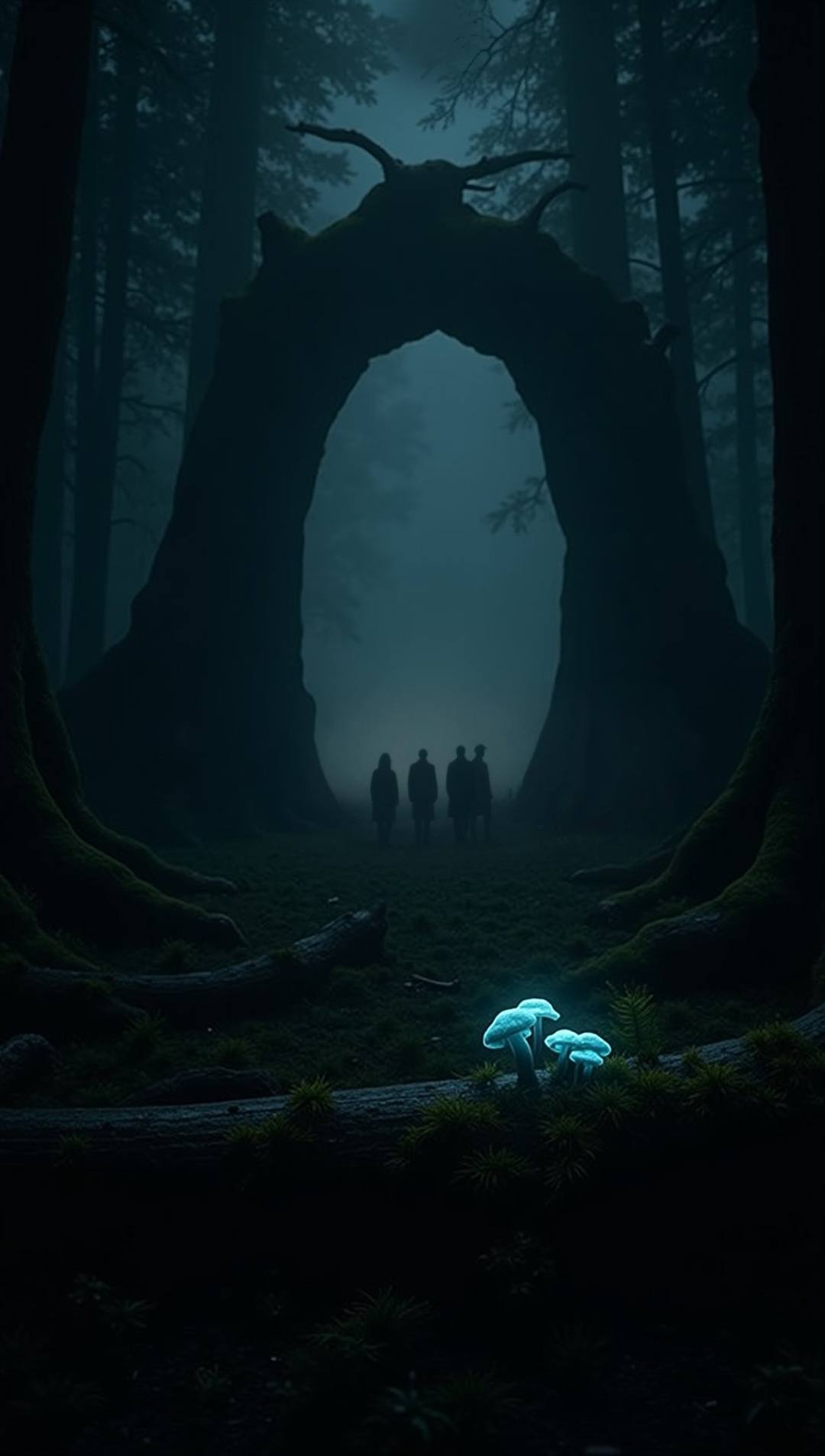
The darkness took the spaces between the trunks before it took the trunks themselves. At the feet of the old trees, wet leaves settled slowly, and beneath a moss-covered fallen trunk a single blue vein woke. The light did not begin as a line; it widened like a thin pulse seeping from inside the bark, then drew back.
For a while nothing changed.
Then the blue thickened again. This time it lit from within not only the cap of the mushroom but the mud around it, the fine roots, the surface of the water-filled prints. The light widened as if drawing breath and shrank as if letting it go; it was not quite regular, and not quite random either. It was as uncertain as the edge a living thing tests before it decides.
No opening was visible. Only one side of the ground darkened more deeply than the other; the moss, the bark, and the water looked the same but no longer behaved alike. There was a border, but it did not look drawn — it lay hidden in the weave like a seam.
Under the earth a low tremor traveled. No one heard it. It was something bones might remember, something teeth might recognize as a faint pressure; it spread not out of the forest but into it.
The blue pulse swelled once more.
It cut off.
Marek Zieliński raised his phone to shoulder height, turned the screen, then touched a corner with his finger as if searching for a line. There was a single bar. There had been two after they left Hajnówka; past the last houses of Białowieża village, the signal had weakened; in the shadow of the sign for the Strict Reserve — Rezerwat Ścisły — it had all but vanished. It did not behave like a fault. It was fading naturally: distance, the old forest canopy, and the warnings for the restricted zone along the border.
The road did not end here. Only the man-made part of it ended.
The mud swallowed the tire tracks within a few meters. Ahead, over the pathless flat, the morning mist hung like a low ceiling. Oak and hornbeam trunks rose out of it in columns; between them the limbs of lindens bent; deeper in, the dark triangles of spruce came into view. As a child Marek had heard the forest's name too often: a UNESCO World Heritage site, the last primeval lowland forest in Europe, a relict tract to be protected. Coming back years later as a tourist felt as strange as inspecting the load-bearing wall of his own old house from the outside.
Hanna Vogel knelt, counting the narrow boxes inside her pack. The German biologist had taken her field notebook out of its plastic sleeve and bound it to her wrist with two rubber bands; the tubes, a small knife, and sample bags were laid out in order. She had supplied the trip's clean pretext. There was a narrowing window for an autumn mushroom inventory in the relict forest before the October rains grew heavy. It was a plan reasonable enough to bring old friends together on the same date.
"Beyond this point, there's no marked route," said Owen Blake.
The English ex-soldier surveyed every opening in the terrain once more before he folded the map. He pinched the shoulder strap of his pack between two fingers, then let it go. For years Marek had known that Owen could not stand in a crowded room without his back to a wall; everyone pretended to know why, and no one asked for the details.
"This is the boundary of the guided-access area," said Hanna. "I only want to see the pockets along the edge."
"There's no such thing as a pocket along the edge," said Owen. "You're either at the boundary or inside it."
Sofia Marchetti did not answer. The Italian data scientist had fixed her phone to a short grip and was recording the sign, the mud, even Marek's hand left hanging in the air. The habit of storing a thing before living it was so settled in her that Marek sometimes wondered whether Sofia gathered memories only to watch them later. She looked through the lens now, then smiled.
"One last time, isn't it?" she said.
No one answered right away. They had known each other since university; they had eaten cheap soup in the same kitchens, given each other false courage before the same exams, then watched the quiet work that life does. The distances had entered the calendars first, then the sentences. They had called this meeting a holiday, a field trip, a small escape after which everyone would go back to their own lives.
"Let's not say one last time," said Hanna. "It sounds old."
Owen let out a short laugh. Sofia recorded that too. Marek tried to smile, but the movement in his face came late, like the settling of an old building.
As an architect he had given his life to permanent things. Cultural centers, town halls, museums, façades that looked good on presentation boards. Each had carried an opening-day crowd, then been left to its own silence.
Behind them, the sign bore its warnings — licensed guide, strict protection. Farther on, a rusted post marking the border line appeared briefly in the mist and was gone.
Hanna took the first step. Owen walked behind her, Sofia raised her lens, and Marek pressed into the mud. With the sign behind them the world did not narrow; on the contrary, it opened without measure. What was being withdrawn, Marek understood, was not some support outside him but a beam he had assumed for years was still in place within.
Evening came, gathering small droplets on the tent canvas. The forest had given them no clearing; they had found only a flat strip of mud between two fallen trunks, where the ferns thinned a little. Owen tested the ground first, then turned the mouths of the tents to face the same way. Hanna moved the wet leaves aside with her glove. Sofia recorded the crackle up close as they tried to light the fire; when the flame would not catch, she kept recording and waited.
As he tightened the lines, Marek looked at how the trunks rose. Białowieża's old trees were not like columns that had learned to bear a load; they held an older, more patient order. Some had hollowed from within, their bark closed over with moss; still they stood, channeling the weight of other limbs through their trunks. Bearing a load was not the same as looking sound.
The fire finally caught, a small amber hollow. The smoke did not fight the mist; it mingled with it. The thermos cap passed from hand to hand. Hanna told the story of the night she accidentally made the whole cabinet in the university lab reek of vinegar. Owen said that to shut off the alarm that night he had gone down to the building's electrical panel. "Even back then you were drawing up an evacuation plan," Sofia said. Owen shrugged.
"Someone had to draw one up."
"And someone shouldn't have left the cabinet door open," said Hanna.
Marek laughed. The laugh was short but real. It was a small piece of mortar still holding between them.
For a while the talk found its old rhythm. Passing the thermos to Owen, Hanna forgot to take off her glove; Owen tried to open the cap with his teeth; Sofia looked at the two of them and murmured something short in Italian. Marek did not catch the word, but he caught its tone. Little moments of incomprehension like this had never come between them.
Now they had no table. Only wet earth, four cups, and sentences left half-finished.
As the night went on the forest, instead of thinning, deepened. Drops passed from leaf to leaf, far off a branch broke under its own weight, and bubbles rose from the bog pockets like the heavy swallowing of mud. When Marek switched off his flashlight, the dark did not fill the trunks but the spaces between them. That was where the cathedral feeling came from: the ceiling could not be seen, yet its weight could still be felt overhead.
Owen took out the compass and held it by the fire. The needle searched briefly for north, found it, then swung back a little.
"Is there metal near it?" Hanna asked.
Owen moved the knife, the steel cup, the phones away. The needle showed the same small hesitation. "Damp, minerals, maybe just my cheap gear," he said. There was a flatness in his voice, as if the matter were closed.
Marek wanted to accept the explanation. During building inspections, most small deviations began the same way: damp in the ground, a measurement error, a tired technician. Then one day the crack would behave more honestly than the explanation itself.
Hanna leaned a little away from the fire. "Look."
The thin mushrooms beneath a fallen log glowed greenish for an instant. The glimmer was so faint that when Marek blinked it was gone. Hanna held up her flashlight and saw nothing. "Could be," she said, more to herself. "Some species have a faint glow."
Sofia raised her phone, but the dark gave only a black surface. "I missed it."
"Maybe there was nothing to miss," said Owen.
As the fire died, the tent zippers closed one by one. Marek lay on his back and counted the roots under the thin mat against his ribs. Outside, the forest vanished again once the light was withdrawn. The compass's small hesitation kept shifting place in his mind. Like a beam set on the wrong bearing point, it did not show where the load came from; it only showed that something did not add up in the calculation.
On the second day, mud built up in layers beneath their boots. They detoured around water pockets marked on no map; fallen trunks sometimes rose to waist height; ferns wiped their wet faces on their trousers. After a point Marek noticed that he was thinking of the way back not by the trees but by the small cloth markers Owen left behind. There were no straight lines in the forest. A person carried the straight line in with them.
In the afternoon the light dimmed. The mist lowered again, but this time there was another brightness near the ground. At first Marek took it for puddles holding the sky. Then the blue came out from under the leaves.
The mushrooms did not grow one by one. They had wrapped one whole flank of a fallen oak, spread down among the roots into the mud, and from there leapt to other trunks as fine filaments. Their caps were small and translucent; the veins running beneath them glowed as if carrying a blue fluid, then went out, then filled again. The light did not stay on the surface. It worked inside the bark, the moss, the water.
Hanna dropped to her knees, almost losing her pack. "No," she said. Then lower, faster: "No, this isn't normal."
"Hanna," said Owen.
As if she had not heard him, Hanna put on a fresh glove and opened one of the sterile tubes. The look on her face was closer to hunger than to joy. "I'm not missing this."
Marek did not catch her wrist. He thought about it, but interfering with Hanna would put too much load on the delicate ground laid between them over the years. "Look first," he said. "Before you take it."
Hanna looked at him for a moment. She seemed to understand what he had said but refused to accept it. The tube stayed open.
Sofia had already started recording. Beside the phone was a small measuring device; its screen tried to turn the blue light into numbers, and the numbers kept changing without settling. Sofia had the focused look of someone watching a concert from behind glass. Instead of looking directly at what was beautiful, she was testing whether what she saw could be recorded.
"Where is all this light coming from?" she asked.
"I don't know," said Hanna. Rather than anger her, the answer drew her further in.
Owen hung back, one hand on his pack strap, his feet ready to turn around. "We don't belong here," he said.
"Where do we belong, Owen?" Sofia asked, without taking her eyes off the screen.
Owen did not answer. Neither did Marek. Because the question was aimed not at the forest but at the four of them.
Marek looked not at the brightness of the light but at its weave. The filaments did not spread at random. Some ran through the cracks of the fallen trunk, some thickened where roots met, some followed an unseen line through the mud. It did not behave like a load-bearing system; still, it let him sense where the load came from and where it went. The blue was not a color brushed onto the material but an inner tension the material itself had chosen.
When they noticed the pulse, they all fell silent.
The light swelled not at fixed intervals but in answer to the same need. First the veins under the log filled, then the caps brightened, then the puddles around them lit briefly from within. With each fading the forest looked a moment darker; with each return, a moment nearer.
Hanna capped the tube but did not put it in her pack. Sofia held the phone in both hands. Owen took a step back. When Marek noticed that his own breathing had fallen into line with the light, he wanted to break it at once; deliberately, he took longer, less regular breaths. After a few cycles the blue seemed to match him again.
The thought was not reasonable. Still, it was there.
Sofia, meanwhile, did not move. While the others looked at the mushrooms, the veins, the water, she tilted her head slightly to one side. She lowered the screen. Her lips parted, but she did not speak. An emptiness came over her face — not as if she had heard something, but as if she had found where something was.
"Sofia?" said Marek.
Sofia blinked. She raised the phone again. "Let's not lose the recording," she said.
Marek did not answer. The blue pulse swelled once more; this time the light left a short, thin line in the mist beyond the mushrooms.
At first the line looked like a gap between branches. When the mist shifted, it should have disappeared, but it did not. With each pulse the blue light reached it, thickened its edges, then drew back. Marek took a few steps. The ground was the same ground: mud, root, crushed leaf. But the distance gave the wrong result. A three-step stretch took five; then a root surfaced under his foot earlier than he expected.
"Stop," said Owen.
No one exactly stopped.
Marek's body fell into an old professional routine. It searched first for the ground, then for the gap between two of his friends, then for the shortest line of retreat. Like knowing where the fire stairs are in a building, it calculated the escape route without naming the danger. But here there was no wall, no corridor, no surface that stayed faithful to the plans a person draws.
Owen's boot left a half-moon print in the mud. The print filled with water at once, then took a blue reflection and, fading, returned to its ordinary darkness. Even something this small demanded too much attention.
The air grew heavy. Without wind the mist changed direction; where it should have flowed between the great trunks, it drew toward the mushroom line. The damp stopped being a wetness that settled on their faces and gathered before them like a thin membrane. For a moment the trees stood too orderly. Marek tried to read their positions as column axes, and the reading broke apart at once.
Hanna had forgotten the tube in her palm. Owen took her by the arm. "Back."
"Wait," said Hanna.
"No."
Sofia slid a few steps to the right; the phone was still recording. She looked not at the screen but at the line. Her fingers were shaking, but she did not stop the recording.
The blue struck every surface at once. The moss on the trunks, the water in the mud, the lens of Hanna's glasses, Owen's map sleeve, the fine fibers left on Marek's hand from the tent line — all of it lit in the same instant. The light did not fall on them from outside; it came out of the objects, as if borrowed from within them for a moment.
Then the line opened.
The tearing was not like cloth ripping. It was more like the load calculation of a wall becoming invalid in an instant: the surface was still there, but the weight was now being routed somewhere else. The edges did not shatter; they grew wet like a living wound, curled, tried to hold themselves together. Marek waited for the collapse of a world. No rubble came. Another order stood in the opening.
Hanna lunged forward. Owen pulled her back. Sofia raised the phone to get a closer shot. Marek stayed between them; he measured the distance one hand would need to reach Hanna, the other to reach Sofia. The measure did not hold.
From the edge of the rift came not light but climate. One side was cold autumn mud; on the other side there was a warm haze. On one side stood Białowieża's damp trunks; on the other, a geography not yet made whole, where shadow and light had traded places. Warm and cold, near and far, inside and outside had been put in the wrong places.
Marek thought of all the thresholds he had drawn in plans over the years, and how each of them only separated two spaces. This threshold, instead of separating, laid two realities one on top of the other.
The rift did not hold steady; it narrowed and widened like an opening that breathed. The blue mushroom line glowed more intensely along its edges, and the filaments climbed out of the earth like wet ropes and caught at the air. When Marek stepped closer, the world beyond the opening moved for the first time from broken glimpses into something continuous.
There the ground was under no obligation to stay ground. Great masses cloaked in vegetation hung in the air, and from beneath them dangled not roots but thin curtains of water. A river, as if it had left its bed, curled upward, then spread in the air and merged into another current. Far off a second heavenly body hung, a pale disk like daylight. The trees looked like trees, but their trunks pulsed here and there like veins, and their branches turned not with the wind but by a slow decision passing through them.
Through the air passed silhouettes that resembled birds. They had wings, but their wingbeats were nothing like those of birds; they were silent and soft, more like a leaf turning underwater. For a while they remained suspended in a line between the heavenly body and the hanging water, then descended into the vegetation. Marek could not make out what they were.
It was beautiful. That did not make it safe.
Marek could not take in the whole view. His eyes searched for a man-made proportion to grip: a step, a wall, a road, an arch. On the side of a mass closed over with vegetation he saw a spine too straight and too regular; it was a thing that looked built to carry a load, but the blue light shifted and the shape blurred back into leaf and water. He could not be sure. He said nothing to anyone.
Hanna opened her mouth, closed it. Owen still had not let go of her arm. Sofia was a few steps ahead, the phone at chest height, the screen on. The small red mark of the recording felt all too familiar to Marek.
Marek saw that the image on Sofia's screen was paler than the living scene. The blue was there too, but its depth was missing; the water curtains became a line, the tree veins a shimmer, the distant figure a smear that could not be resolved. Still Sofia did not turn off the screen. An imperfect recording was more bearable to her than none at all; Marek knew this not from her expression but from the movement of her hand, repeated for years.
Then, far off in the opening, Marek saw a figure.
The figure stood on no rise; only distance and mist made it small. It did not move. What it wore was too indistinct to be called either old or new. It stood as upright as a person, as silent as a shadow. It did not approach. It did not raise a hand. It did not speak.
"There's someone out there," said Marek.
Owen followed his gaze. "I see it."
Hanna said a word under her breath; Marek could not hear it, but this time what he did not hear did not matter. Sofia, however, reacted differently. She lowered the phone. The muscle along her jaw tightened. She turned her head again at that slight angle: first toward the mushroom line, then into the rift. Marek heard nothing. The forest dripped, the filaments glowed, the distant world stood, arranged all wrong. That was all.
"Do you hear it?" said Sofia.
"Hear what?" said Owen.
Sofia did not answer. She did not raise a hand to her ear; she acted as if this had nothing to do with hearing. She seemed to be resisting a low pressure passing between her teeth. On her face Marek saw recognition more than fear, though he could not tell what she recognized.
"Sofia, come back," said Marek.
Sofia did not take her eyes off the rift. The blue pulse came now not from the mushroom line but from the edges of the opening. With each swell Sofia's face lit; with each fading, she seemed to recede again. The hand holding the phone dropped to her side; the recording continued. She took a step.
Owen let go of Hanna. "Sofia."
The second step fell on the line where the mushrooms began. The mud glowed blue briefly under her foot. Marek threw himself forward, but again the ground gave the wrong distance; his hand reached not Sofia's shoulder but the empty space between them.
"Sofi—"
The blue surged all at once. Sofia did not complete her step, Marek's hand stayed in the air, and the edge of the rift pulled inward like a wet membrane.
Even the soundest threshold collapses when the load comes in from the wrong place.
Episode complete; the next is in the app.
Episode 2 is in the app and free. It unfolds through sound, touch, and a full-screen cinematic opening.
GO TO EPISODE 2 App Store Back to series